Swiss Romand news: which media outlet suits your profile?
REMP circulation figures, CHF prices, cantonal coverage: a factual comparison of Romand news sources for swift professional decision-making.
20 Minutes, Le Matin, TDG: real audiences in French-speaking
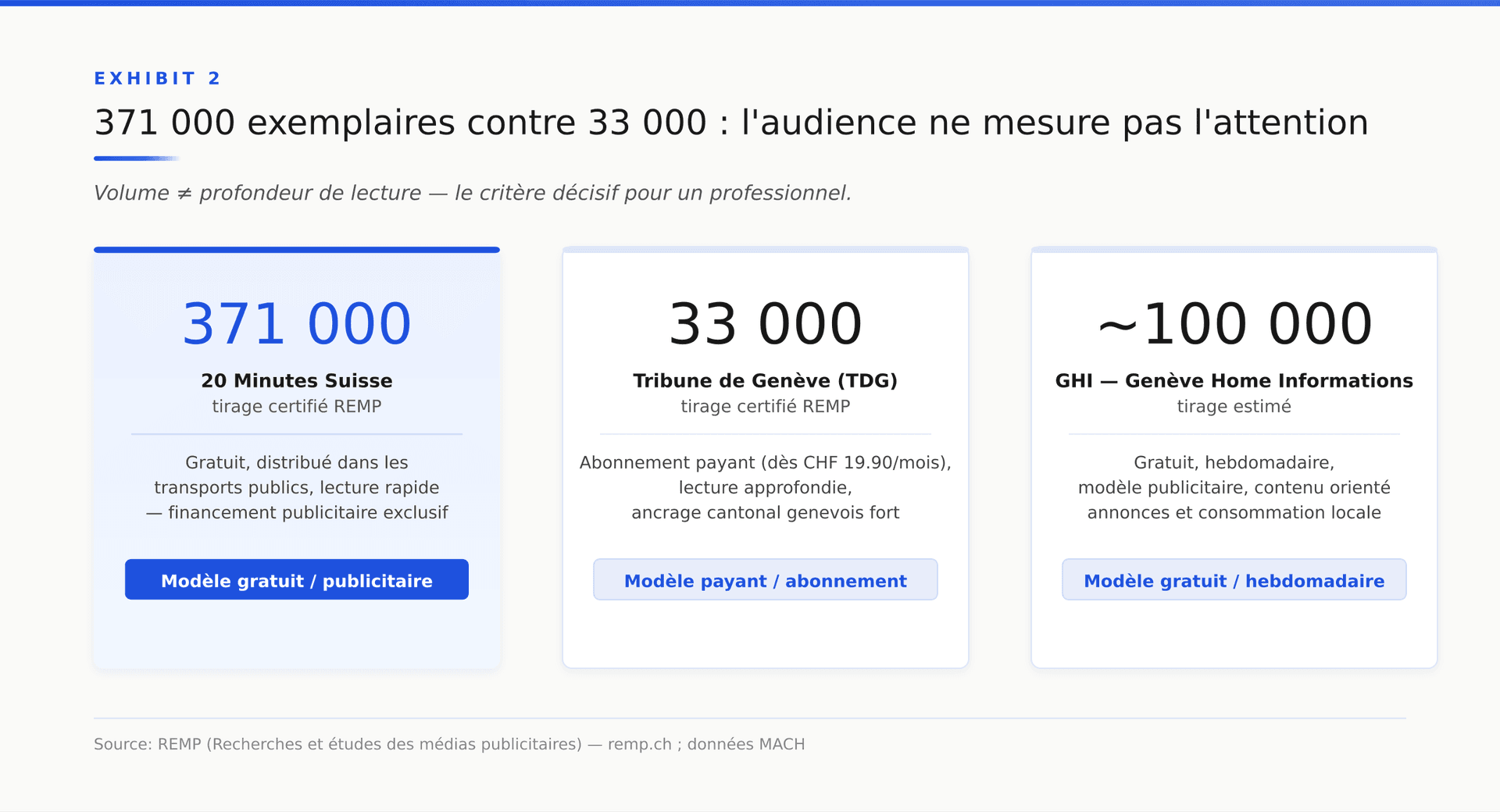
REMP and MACH figures allow titles to be compared without approximation. 20 Minutes Suisse reports a REMP-certified circulation of 371,000 copies across all editions. It is the most widely distributed title in French-speaking Switzerland, distributed free of charge on public transport and at high-footfall transit points.
Le Matin discontinued its daily print edition in 2018. Since then, the title has existed solely in digital form under tamedia, with no REMP-certified circulation applicable to a print format. Its digital audience continues to be measured via NET-Metrix, but 2026 data had not yet been publicly consolidated at the time of publication.
La Tribune de Genève (TDG), also under tamedia since 2020, has a certified circulation of approximately 33,000 copies according to the most recent available REMP data. It remains the reference title for Geneva coverage, with a cantonal presence superior to that of 20 Minutes on local political matters and institutional agendas.
Comparing these three titles on the same basis requires distinguishing between gross audience and net audience. 20 Minutes reaches a larger volume of readers, but with a rapid reading rate. TDG and Le Matin numérique address a readership that spends more time per session. For a self-employed professional or SME manager, this criterion of reading depth determines the practical value of a title according to the type of decision at hand.
Swiss Romand news: which media outlet suits your profile? — 371,000 copies versus 33,000: circulation does not measure attention
Free access vs paid subscription: prices in CHF
The freemium model dominates the Romand market today. Several titles offer partial access without a subscription, followed by a paywall for long-form articles or thematic dossiers.
20 Minutes Suisse: full access free of charge, no digital subscription required. Exclusively advertising-funded.
Le Matin numérique: freemium model, partial paywall. Digital subscription at approximately CHF 12.90/month depending on the tamedia offer in force.
Tribune de Genève: digital subscription from CHF 19.90/month. Unlimited access to Geneva cantonal articles included.
Le Temps: CHF 39/month for a full digital subscription. This is the highest price point in the Romand segment, justified by denser federal and international coverage, as well as long-form content and structured economic data.
ArcInfo (Arc jurassien [Jura Arc], Neuchâtel): digital subscription around CHF 19/month. Fine cantonal coverage for professionals active between Neuchâtel and the Jura border.
Le Nouvelliste (Valais): pricing similar to ArcInfo, around CHF 18 to 20/month depending on the package. Valais coverage, including tracking of cantonal decisions and local markets.
A Le Temps subscription costs CHF 39/month, ArcInfo CHF 19/month: if your activity is concentrated in the Jura Arc, the question is best approached the other way round. Paying twice as much for national coverage is only relevant if the federal regulatory agenda forms part of your daily monitoring.
For a liberal profession whose scope of activity remains cantonal, a single digital subscription between CHF 18 and CHF 20/month covers the bulk of relevant local news. Combining three subscriptions amounts to CHF 60 to 80/month — a cost to be weighed against the time actually devoted to each title.
Arcinfo, GHI, Le Temps: cantonal coverage for self-employed
Cantonal coverage is not uniform across titles. Three objective criteria allow it to be assessed: frequency of local article publication, presence of journalists based in the canton, and monitoring of the cantonal regulatory agenda.
ArcInfo covers the canton of Neuchâtel and the Jura Arc with a local editorial team. The title publishes articles on decisions of the Neuchâtel Conseil d'État [State Council], public tenders, and amendments to the cantonal law on commerce. For a self-employed professional in Neuchâtel, it is the most direct primary source on local regulatory changes.
Le Genève Home Informations (GHI) is a free weekly distributed in the canton of Geneva. Circulation of approximately 100,000 copies according to available data. The model is advertising-based, with content oriented towards local consumption and announcements. Useful for visibility in advertisements, less relevant for regulatory monitoring.
Le Temps addresses cantonal news in a secondary capacity. The title publishes an average of 3 to 5 articles per week on Romand cantons outside Geneva. Its added value lies in federal coverage and access to primary federal sources: decisions of the Conseil fédéral [Federal Council], OFSP [Federal Office of Public Health] consultations, and amendments to the OAMAL [Ordinance on Health Insurance]. For monitoring an ongoing federal consultation, Le Temps remains the only Romand title to provide regular coverage with reference to the legislative texts published on fedlex.admin.ch.
Le Nouvelliste publishes daily on Valais with an editorial team in Sion. Tracking of cantonal decisions, the Valais property market, and infrastructure projects is documented with a frequency that Le Temps cannot match within this geographical area.
Geneva, Neuchâtel, Vaud: editorial differences and local information
Three cantons, three distinct editorial logics. The differences do not lie in register or style, but in the institutional structure of each canton and the titles that stem from it.
Geneva has a denser media landscape than other Romand cantons. TDG, GHI, and RTS Genève cover the same territory from different angles. TDG provides in-depth political and economic coverage. GHI covers the local commercial fabric. RTS handles major developments on a continuous basis. A professional based in Geneva can cross-reference three sources on the same cantonal event — which enables verification, but also informational overload.
Neuchâtel presents a more concentrated situation. ArcInfo holds a dominant position in the canton. ArcInfo's REMP-certified circulation data are not publicly available in a consolidated 2026 format, but the title remains the primary source for decisions of the Neuchâtel Grand Conseil [Grand Council]. The absence of a direct local competitor means that cross-checking requires either RTS or official cantonal sources directly.
Vaud is covered principally by 24 Heures, a tamedia title with a REMP-certified circulation of around 55,000 copies according to the most recent available data. 24 Heures' Vaud coverage includes Lausanne, but the density of coverage in the northern Vaud regions or the Chablais is less uniform. For a self-employed professional active in Yverdon or Aigle, 24 Heures' local coverage remains superior to that of any national Romand title, but may present gaps for communes with fewer than 10,000 inhabitants.
Le Monde vs Romand media: where usefulness ends for a Swiss reader
Le Monde covers Switzerland in an average of 4 to 6 articles per week — useful for European context, but of no use for monitoring an ongoing federal consultation. This figure represents the title's principal limitation for a professional reader based in French-speaking Switzerland.
A Le Monde digital subscription is around 9.99 euros/month (approximately CHF 9.50 at the current rate), which is less than a TDG or Le Temps subscription. The price-to-utility ratio depends entirely on the required scope of monitoring.
For a professional whose activity is tied to French partnerships or European markets, Le Monde provides macroeconomic and political coverage that Romand titles do not offer. For a self-employed professional focused on the Swiss market, Le Monde covers the OFSP [Federal Office of Public Health] in near-absence, does not access federal consultations on fedlex.admin.ch, and does not monitor amendments to the Ordonnance sur l'assurance-maladie (OAMal) [Ordinance on Health Insurance].
News.google.com aggregates both universes without editorial selection. Google News' algorithm for French-speaking Switzerland weights sources according to their domain authority, not their professional relevance. 20min.ch, lematin.ch and lemonde.fr appear in the same feeds, with no hierarchy based on geographical or regulatory anchorage. This is useful for a rapid overview, but insufficient for structured monitoring.
20minutes.fr, the French version of 20 Minutes (publisher Reworld Media, distinct from tamedia), does not cover Switzerland. The similar URLs between 20min.ch and 20minutes.fr frequently generate confusion in searches. The two titles have had no editorial connection since the separation of their structures in 2017.
Aggregators, newsletters, alerts: filtering without losing 45 minutes
Unstructured consumption of news represents a real cost. Forty-five minutes per day spent browsing unfiltered feeds amounts to approximately 180 hours per year — a figure that few self-employed professionals or managers can absorb without impact on their activity.
Three tools allow this time to be reduced without sacrificing coverage.
First tool: Google Alerts configured on precise keywords (name of commune, federal law number, name of cantonal body). An alert on 'OFSP' or 'OAMal 2026' surfaces relevant articles without the need to browse an entire site.
Second tool: newsletters from subscribed titles. TDG, Le Temps and ArcInfo offer daily or weekly newsletters summarising cantonal articles. The average reading time for a well-configured newsletter is 4 to 7 minutes. This is the format best suited to professional monitoring under time constraints.
Third tool: direct primary sources. For federal decisions, the Feuille fédérale [Federal Gazette] published on fedlex.admin.ch is the most reliable primary source. Press titles relay these decisions with a delay of 24 to 72 hours depending on their coverage. A professional whose activity depends on the federal regulatory agenda is better served by consulting the Feuille fédérale directly rather than awaiting media relay.
Aggregators such as Google News remain useful for a rapid review of the information landscape. They do not replace structured monitoring from identified sources. The distinction between aggregation and monitoring is operational, not merely semantic.
Summary table: choose according to your actual usage
Below is a factual summary of the principal Romand titles across three criteria: available circulation or audience, digital subscription price in CHF/month, and principal cantonal anchorage.
Le Monde — Swiss coverage: 4 to 6 articles/week — Price: ~CHF 9.50/month — Canton: no cantonal anchorage
The selection rule is straightforward: first define your geographical scope of activity, then your need for federal regulatory coverage. If your activity is cantonal, a regional title at CHF 18–20/month covers the essentials. If your monitoring includes the federal agenda, Le Temps or direct primary sources (fedlex.admin.ch, bag.admin.ch) are more effective than accumulating multiple regional subscriptions.
"The information published on golamal.ch is provided for purely informational purposes and does not constitute legal, financial or investment advice. Golamal.ch operates under FINMA registration number F01502264. Any decision remains entirely your own responsibility."
FAQ
20min.ch is published by tamedia in Switzerland and covers Swiss news. 20minutes.fr is published by Reworld Media in France and covers French news. The two titles have had no editorial connection since 2017. They sometimes appear in the same Google search results, which frequently generates confusion. A reader based in French-speaking Switzerland will not find any Swiss content on 20minutes.fr.
Le Temps is the Romand title that most regularly covers OFSP [Federal Office of Public Health] decisions and federal consultations. To access legislative texts and ordinances directly without waiting for media relay, fedlex.admin.ch and bag.admin.ch are the most reliable primary sources and are freely accessible.
This depends on the scope of activity. Le Temps at CHF 39/month covers the federal and Romand agenda broadly but with limited depth at cantonal level. Two regional subscriptions at CHF 19/month each (e.g. TDG + ArcInfo) cost the same amount and offer finer cantonal coverage if the activity is located within those two areas. The two options are not interchangeable.
Le Monde publishes an average of 4 to 6 articles per week on Switzerland. This frequency is sufficient for general European context, but insufficient for monitoring the cantonal agenda, Conseil fédéral [Federal Council] decisions, or Swiss regulatory amendments. A Le Monde subscription does not replace a Romand title for professional monitoring anchored in Switzerland.
Three concrete steps: configure Google Alerts on precise regulatory keywords, subscribe to daily newsletters from selected titles (4 to 7 minutes of reading on average), and consult the Feuille fédérale [Federal Gazette] directly on fedlex.admin.ch for official decisions without waiting for media relay. This combination covers 80% of standard professional monitoring needs.
REMP-certified circulation is the number of copies distributed or sold, verified by REMP (Recherches et études des médias publicitaires [Research and Studies of Advertising Media]), an independent body based in Switzerland. This figure is distinct from net audience (the actual number of readers, often higher than circulation since a single copy may be read by several people). It is the reference figure used by advertising agencies to set advertising rates.



 GoLamal Team